









Analysis: Rayo Vallecano vs AEK Athens – Profiling the Greek Super league leaders
Written by David Smith
On the surface, next Thursday’s quarter-final clash between Rayo Vallecano and Greek club A.E.K Athens may seem like just another European knockout game. Different colours, distinctly different European histories and they sit at opposite ends of their respective league tables. But there is more here than meets the eye.
Both teams were founded in 1924, becoming a symbol of pride for their tight-knit, working-class communities. The areas the clubs were founded were heavily shaped by migration. The Vallecas district became home to many Spanish workers from rural areas while Nea Filadelfeia became the refuge for Greeks fleeing from the ‘Asia Minor Catastrophe’. The crests of both teams reference a historical past; Rayo showcases the Vallecas coat of arms, representing the municipality’s prior independence from Madrid while AEK boasts the double-headed eagle, a symbol of the Byzantine Empire.
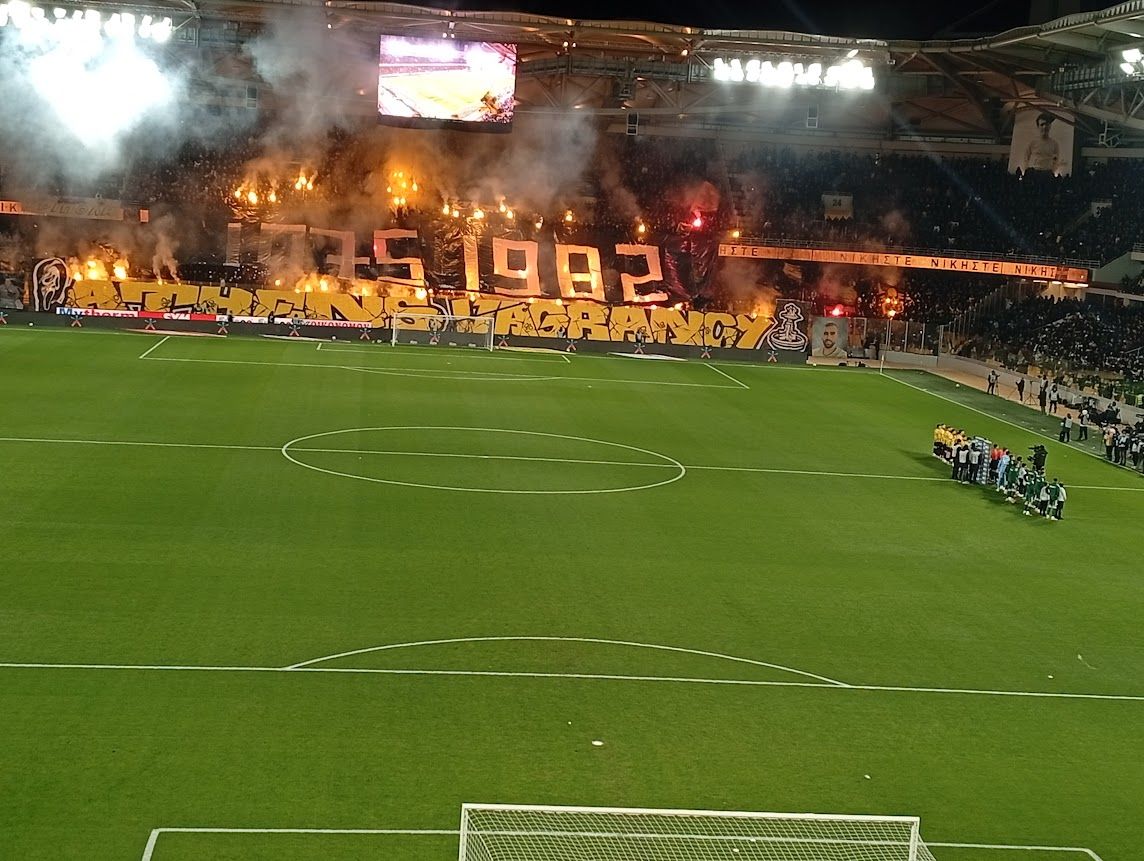
These identities are now represented by the Bukaneros (Rayo) and Original 21 (AEK) ultra groups. Steeped in left-wing ideology, they both frequently display anti-fascist and pro-Palestinian messaging and are the heart and soul of their respective fanbases. From the lows of the third division to the highs of European knockout football, their loyalty has never wavered.
But that is where the parallels between the two clubs end. Rayo have suffered four relegations this century alone while AEK have only been relegated once in their entire history. Upon being relegated in 2013, the club opted to drop straight to the third tier to eliminate their debt. Since returning to the first tier in 2015, AEK has won the league twice and have qualified five times for the main phase of all three European competitions.
AEK’s tactical identity
This season was meant to be a reset after the final season of recently sacked Sevilla manager Matias Almeyda. The Argentinian won the domestic double in his first season by instilling a high-tempo playing style, aiming to suffocate the opponent in their own half. He won the domestic double in his first season but his last proved to be a disaster, being knocked out in the Conference League qualifiers by Armenian side Noah and losing all six games in the Championship play-offs.
Over the summer Serbian coach Marko Nicolic took over, aiming to restore confidence in the players and rebuild the squad. He successfully navigated all three rounds of Conference League qualifying and has the club entering the Championship play-offs in first place. In the Conference League league stage, the club finished third, two places above Rayo, granting AEK the advantage of playing the return leg at home. 
The other advantage AEK has is that they don’t have a league fixture sandwiched in between the two ties with Rayo, due to Orthodox Easter Sunday. Away from home in Europe, the Greeks managed impressive victories against Samsunspor and Fiorentina as well as a dominant 4-0 win in Slovenia against Celje in the round of 16.
Nikolic employs a fluid 4-2-2-2 formation in possession, aiming to create numerical overloads in the half-spaces and confuse the opponent with constant positional rotations. The squad also possesses rapid wingers who are able to change the course of a game with their one-on-one ability, adding another dimension to the team’s attack. The most well-known name in the squad is former Real Madrid striker Luka Jovic, who has been in exceptional form.
His current league tally is one goal shy of his career best of 17 goals and along with January signing Barnabas Varga, they have formed a formidable partnership. Jovic likes to receive between the lines and drive the ball forward or combine with other midfielders; Varga on the other hand thrives from crosses into the box and from set-pieces, scoring six and assisting twice. 
In defence, AEK initially remained in their own half in a passive 4-4-2 mid-block but Nikolic quickly adjusted. Best showcased in the win against Fiorentina, AEK were able to adopt during games a 4-2-4 man-to-man pressing structure and force turnovers. Players also started positioning themselves higher up the pitch when pressing, as shown away against title rivals PAOK, and proved able to quickly return into a more defensive shape in case of a defensive transition.
AEK fare better when they are able to control the rhythm of the game and create transitions through fast combinations in the middle. The state of controlled chaos that prevailed under Almeyda does not suit them anymore, as seen in a 3-2 victory against Universitea Craiova.
The Romanian opposition deployed a high defensive line and played a fast, vertical brand of football, similar to how Rayo aims to create counter-attacks by getting the ball forward as quickly as possible. The space left in-behind Craiova’s defence tempted AEK to play quick vertical passes instead of patiently building their attacking sequences. The result was that the Greeks were unable to effectively counterpress and ended up being vulnerable in quick transitions of play, going 2-0 down in the 70th minute as a result.
That game also highlighted the main weakness of the current squad which is the absence of a more defensive minded midfielder. Former Celta Vigo midfielder Orbelin Pineda has re-invigorated himself as a deep-lying playmaker, breaking opposition lines with his passing and dribbling. That crucial function does carry risk though, and inevitably leads to the chance to win the ball back high up for the opposition. The full-backs have also been liable in recent games to forfeit possession under pressure, another issue Inigo Perez might seek to exploit.
AEK are still a team under construction, with the vision of Nikolic and sporting director Javier Ribalta yet to be fulfilled. The latter commented that the team will take until next summer to reach its final phase and address all the current weaknesses. In comparison, Rayo are a well-drilled side under Perez, with his side boasting a clear tactical identity on the pitch. Their main weakness, famously, has been the absence of a good striker who is able to effectively convert the many crosses his teammates make into the box. But if they can suffocate ΑΕΚ at their home stadium and impose their relentless rhythm, the aforementioned advantages the Greeks can be nullified.
It’s a fascinating tie in prospect, between two sides looking at what is a rare opportunity. Rayo are in just their second-ever European campaign, while AEK are hoping to reach their first European semi-final since 1977.
The post Analysis: Rayo Vallecano vs AEK Athens – Profiling the Greek Super league leaders appeared first on Football España.
What's Your Reaction?
 Like
0
Like
0
 Dislike
0
Dislike
0
 Love
0
Love
0
 Funny
0
Funny
0
 Angry
0
Angry
0
 Sad
0
Sad
0
 Wow
0
Wow
0