








Analysis: Are Barcelona teetering on the verge of crisis?
Last season, it was not unusual to hear Barcelona’s system described as a high-wire act, if not suicidal. Sounding a little like a race car or a suspiciously cheap health supplement, the high line, high pressing, high octane approach seemed to baffle the world, incapable of comprehending how other teams weren’t getting the better of a puzzle with a such a seemingly simple solution. In their last two games, defeats to Girona and Atletico Madrid, Barcelona were beaten in similar fashion by teams who breezed beyond their high line with alarming ease. Barcelona looked down.
The sense of vertigo was palpable at the Metropolitano, four goals conceded in the first half, their worst defeat to Atletico in 86 years, mortality staring the Blaugrana players in the face. It’s not the first time that Barcelona have been beaten, nor the first time their high line has been exposed, but this time there was fear for their own safety, and thunderous Metropolitano gorged on it.
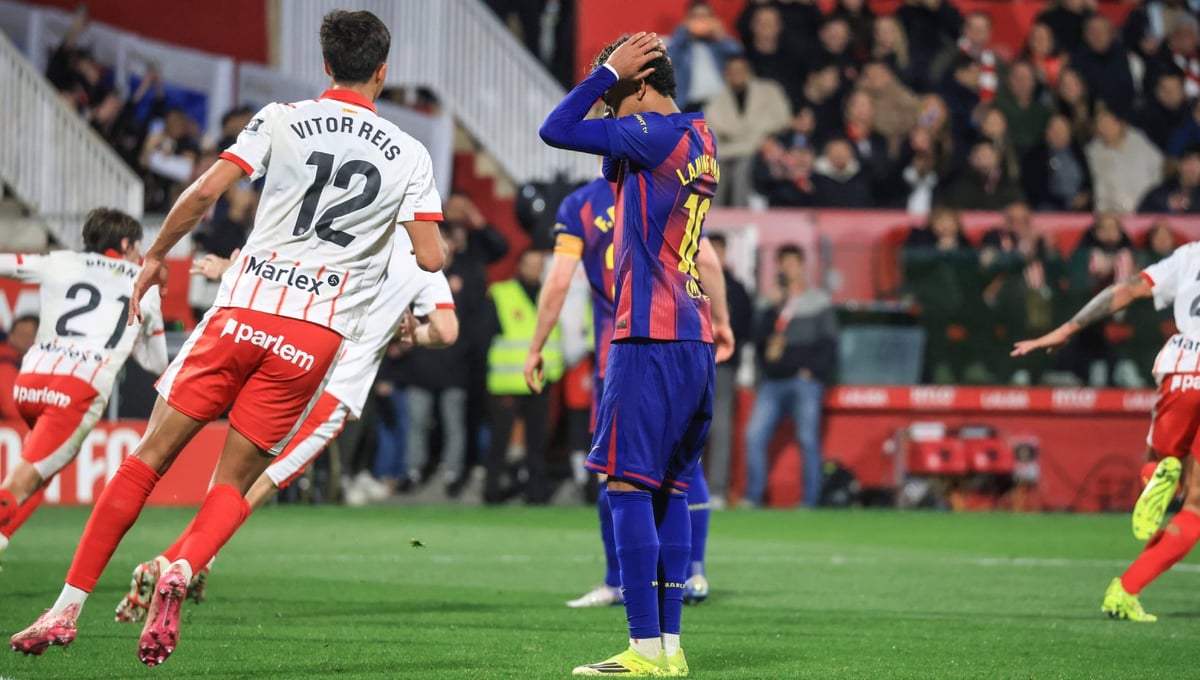
Four days later at Montilivi, Barcelona were supposed to react. Hansi Flick, by all accounts rather stormy himself in the aftermath of their Atletico armageddon, was supposed to intimidate his players back into their usual mindset. Girona did not inflict as much damage, and it was a late, controversial winner from Fran Beltran that probably nudged us into this wider existential examination of Flick’s approach. Recounting the game itself thpough, Barcelona’s defending was beaten in the same way, at a frequency that wasn’t all that distant from what had occurred four days earlier.
What the analyses from last season often left out was that Barcelona’s approach was a calculated risk. Compared to this stage last season in La Liga, Barcelona have seven more points, have scored one less goal (64) and conceded one less too (24). The numbers are not dramatic, but no appraisal of a team in El Clasico truly makes sense without the real point from which the measuring stick is placed; in this case an improved, at least numerically, Real Madrid.
Last season Flick was able to look at his team and conclude that his side had a capacity to score goals that very few others, especially in Spain, could live with. Picking up Xavi Hernandez’s sketchwork, he designed the blueprint for the most effective use of Raphinha. If his pressing was one-paced and his ability to drop into midfield intermittent, Robert Lewandowski’s predatorial instincts remained beyond doubt. Lamine Yamal was the nexus. Either he could get the ball to them, or ensure that enough of a SWAT team had been sent to stop him that there was plenty of space for someone else to.
That combination allowed Flick to gamble on his backline getting beat four or five times a game, and once or twice, conceding. The trade off was that his side would get five or six chances, and with those three in space, Flick could feel comfortable telling the dealer to twist until he got the cards he wanted.
Hansi Flick held a one-hour meeting with the players today to spark a reaction after defeats to Atlético Madrid and Girona FC. he demands intensity, high pressing, tactical discipline, and finishing efficiency. His style is non-negotiable. [@RogerTorello] pic.twitter.com/M9OBDLSHSc
— barcacentre (@barcacentre) February 19, 2026
Even if Barcelona’s overall numbers don’t differ much, the front three tell a story that better resembles the gusts they are subjecting rivals to, as opposed to the hurricane of last season. At the same stage, Diario AS point out that their trio of forwards had scored 68 goals and given 37 assists, compared to 41 goals and 21 assists this season. Between Raphinha’s injuries and Lewandowski’s soft benching, their minutes have dropped by 50%. The Polish veteran has had peaks and troughs at Barcelona before, securing strong numbers to sustain him through a mixed eye test. This season, his teammatescarcely look for Lewandowski in the box, a sign that Flick’s loss of faith is founded on an internal squad consensus.
Beyond their absences, the two most obvious changes are Inigo Martinez and Pedri. The Basque defender has been replaced for the most part by Eric Garcia, who despite Barcelona’s defensive struggles stands out as one of their best players this season. Whether it is the lack of Martinez, or a natural dip after 18 excellent months, Pau Cubarsi has not looked the same next to him. As a partnership, not only are they a decade lighter on experience, Garcia and Cubarsi are too homogenous, they were brought up on the same teaching, and they see the same solutions.
Just as Martinez provided a natural counterweight to Cubarsi, Pedri is the nuance in Barcelona’s aggressive style. Frenkie de Jong thinks vertically, Dani Olmo thrived in the Bundesliga’s counter-attacking haven, and in the football of two decades earlier, Fermin Lopez likely would have found himself playing in a front two off a number nine – for which Lewandowski is a better foil than Ferran Torres. Manufacturing time in the middle of the pitch, understanding the current of the game, Pedri makes the chaos Flick wants to cause deliberate. English is yet to really find a way to synthesize what Pedri has beyond borrowing ‘pausa’ from Spanish. This year he has missed 13 games, absent just once last year at this stage.
Before those consecutive defeats, Barcelona were on a run of 15 wins in 16, and with Pedri and Raphinha returning to fitness, there are reasons for Flick to believe that he can still categorise them as a blip. Montilivi was the first time Barcelona have lost this season with Raphinha in the starting XI. Two free midweeks and home games against 19th-place Levante, and Villarreal, yet to take a point from the top three, are optimal conditions for Flick to conduct a full medical.
The big concern is that a report emerged on Friday night after the Atletico defeat stating that the players had discussed altering their approach with Flick, reducing the risks taken when Pedri and Raphinha weren’t available. Against Girona, Barcelona’s line was as high as it was in Madrid, higher than it has been for large chunks of the season – a clear indication of Flick’s opinion on that idea.
Life goes on. pic.twitter.com/GByxAUN0KY
— FC Barcelona (@FCBarcelona) February 16, 2026
If Flick’s players are beginning to doubt his idea though, to feel as exposed and vulnerable as was claimed last season, then the crisis is real. The room for hesitation in the game of fine margins sought by Flick is non-existent, and their clashes against Girona and Atletico was a visual manifestation of that doubt. No matter the system or approach, any manager is in dangerous territory if his players are second-guessing their instructions, but in the context of how Barcelona play, breakdowns aren’t just eroding confidence, but shearing large chunks away.
With the aforementioned changes, the tightrope is even thinner. Even if Barcelona can find the missing symbiosis between their press and their offside trap, Flick is working on the same calculated risk, but the equation has changed. Given he seems unwilling to contemplate changing the formula, Flick must find a way of reducing the variables, because for the first time since arriving at Barcelona, answers are being demanded internally.
The post Analysis: Are Barcelona teetering on the verge of crisis? appeared first on Football España.
What's Your Reaction?
 Like
0
Like
0
 Dislike
0
Dislike
0
 Love
0
Love
0
 Funny
0
Funny
0
 Angry
0
Angry
0
 Sad
0
Sad
0
 Wow
0
Wow
0